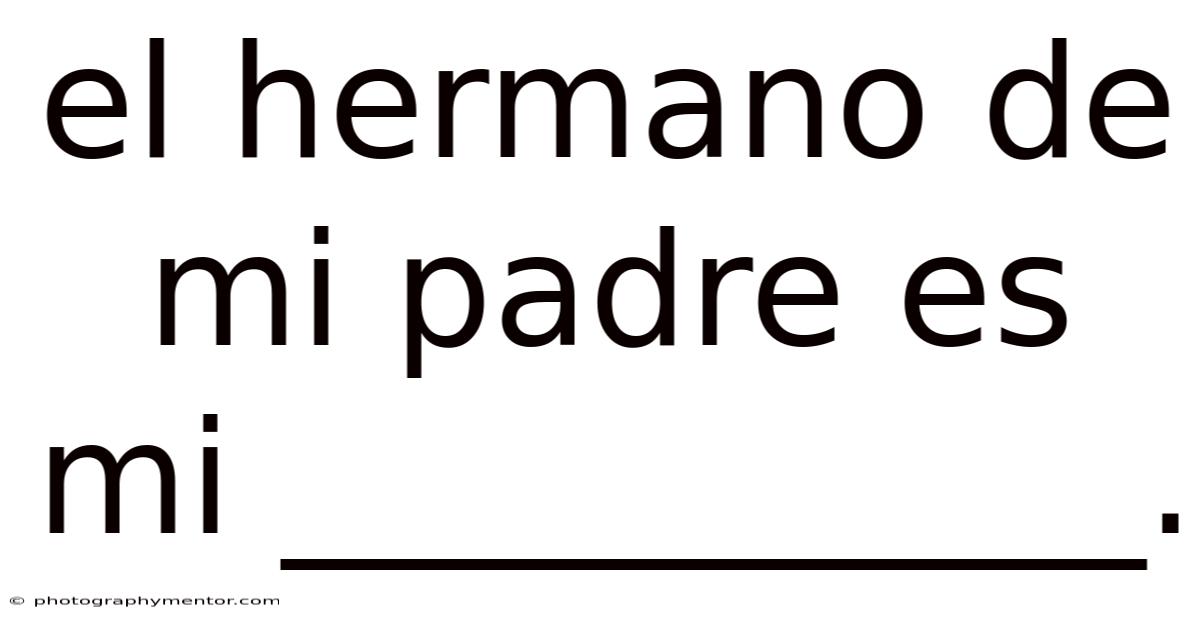
El Hermano de Mi Padre es Mi ___________: Understanding Family Relationships in Spanish
This article explores the Spanish phrase "El hermano de mi padre es mi ___________," focusing on the correct answer and expanding on the broader topic of understanding family relationships in Spanish. Learning family vocabulary is crucial for effective communication and cultural understanding within the Spanish-speaking world. This article will not only provide the answer but also get into the nuances of family terminology, offering a complete walkthrough for learners of all levels.
Introduction
The question "El hermano de mi padre es mi ___________" translates to "My father's brother is my ___________" in English. The correct answer, of course, is tío (uncle). Understanding why it's tío and exploring other related terms will solidify your comprehension of Spanish family relationships and improve your overall language proficiency. Even so, simply knowing the answer isn't enough. This article will cover various family terms, providing examples and explanations to help you confidently deal with conversations about family in Spanish.
Understanding Tío
Tío is the standard term for uncle in Spanish. It refers to the brother of your father or mother. This seemingly simple word encompasses a vital role within the Hispanic family structure, often representing a figure of authority, guidance, and affection. The warmth and closeness associated with tío often extend beyond the biological definition, sometimes encompassing close family friends who hold a similar role in the family Simple as that..
Expanding Your Family Vocabulary: Beyond Tío
While tío answers the initial question, mastering Spanish family terminology requires exploring other related terms. Let's examine some key vocabulary words:
- Padre: Father
- Madre: Mother
- Hermano: Brother
- Hermana: Sister
- Abuelo: Grandfather (father's father)
- Abuela: Grandmother (father's mother)
- Abuelo: Grandfather (mother's father)
- Abuela: Grandmother (mother's mother)
- Tía: Aunt (sister of your father or mother)
- Primo: Cousin (son of your aunt or uncle)
- Prima: Cousin (daughter of your aunt or uncle)
- Sobrino: Nephew (son of your brother or sister)
- Sobrina: Niece (daughter of your brother or sister)
- Suegro: Father-in-law
- Suegra: Mother-in-law
- Yerno: Son-in-law
- Nuera: Daughter-in-law
Using Demonstrative Pronouns with Family Terms:
To further refine your understanding, consider using demonstrative pronouns ( este, ese, aquel ) to specify which family member you're referring to. For example:
- Este tío: This uncle (the one close by)
- Ese tío: That uncle (the one a bit further away)
- Aquel tío: That uncle (the one far away)
This adds a layer of precision to your communication and demonstrates a deeper understanding of the nuances of the Spanish language.
Regional Variations and Informal Terms:
It is important to remember that, like any language, Spanish exhibits regional variations. While tío and tía are widely understood and accepted, informal terms or slight variations might exist depending on the specific region or family. These are usually subtle and understanding the core vocabulary will allow you to comprehend these regional nuances easily Practical, not theoretical..
Practical Application: Constructing Sentences
Let’s build upon our vocabulary to create more complex sentences:
- Mi tío es muy amable: My uncle is very kind.
- Visité a mi tía el fin de semana pasado: I visited my aunt last weekend.
- Los primos de mi hermano son muy divertidos: My brother's cousins are very funny.
- Mi abuela me contó muchas historias: My grandmother told me many stories.
- Pasé las vacaciones con mis sobrinos: I spent the holidays with my nephews.
The Importance of Context in Understanding Family Dynamics:
The way family terms are used can often reflect cultural nuances and family dynamics. Here's one way to look at it: the level of formality used when addressing family members can vary greatly across different Hispanic cultures. Observing how native speakers use these terms in different contexts will help you understand these subtleties better.
Delving Deeper: Exploring Extended Family
The Spanish language also has words for more distant family members:
- Bisabuelo/Bisabuela: Great-grandfather/Great-grandmother
- Tatarabuelo/Tatarabuela: Great-great-grandfather/Great-great-grandmother
- Primos segundos: Second cousins
These terms are less frequently used in everyday conversation but are important for a more comprehensive understanding of family terminology.
The Emotional Connection: Family in Hispanic Culture
Family plays a central role in many Hispanic cultures. Strong family ties and close-knit relationships are often emphasized. Understanding the vocabulary related to family is essential for appreciating and engaging with this aspect of Hispanic culture. Learning the language is not just about memorizing words; it's about understanding the cultural context in which they are used.
Frequently Asked Questions (FAQ)
-
What if my father has a stepbrother? Do I still call him tío? While the traditional meaning of tío refers to a biological brother, many families extend the term to include step-brothers and even close family friends who fill a similar role. Context is key.
-
Are there gender-neutral terms for family members in Spanish? While Spanish generally uses gendered terms, the use of gender-neutral language is becoming more common in certain contexts, especially when referring to individuals who identify outside of the traditional gender binary And that's really what it comes down to. Turns out it matters..
-
How do I address my uncle formally and informally? Formally, you would use "Señor/Señora + surname" or "Tío/Tía + surname." Informally, "Tío/Tía" is sufficient.
-
What if I don't know the exact relationship? It is always acceptable to politely inquire about someone's relationship to another family member rather than making an assumption.
Conclusion: Mastering Family Relationships in Spanish
Answering "El hermano de mi padre es mi tío" is only the first step in mastering Spanish family vocabulary. Remember to practice using these words in conversation to solidify your learning and enhance your ability to communicate effectively in Spanish. On the flip side, this article provided a more comprehensive understanding of related terms and the cultural context surrounding them. By expanding your vocabulary and understanding the nuances of family relationships in Spanish, you not only improve your language skills, but also gain a deeper appreciation for the richness and complexity of Hispanic cultures. Continue to explore and learn more about the cultural contexts in which these terms are used to truly master the language and become a more confident and fluent Spanish speaker.
