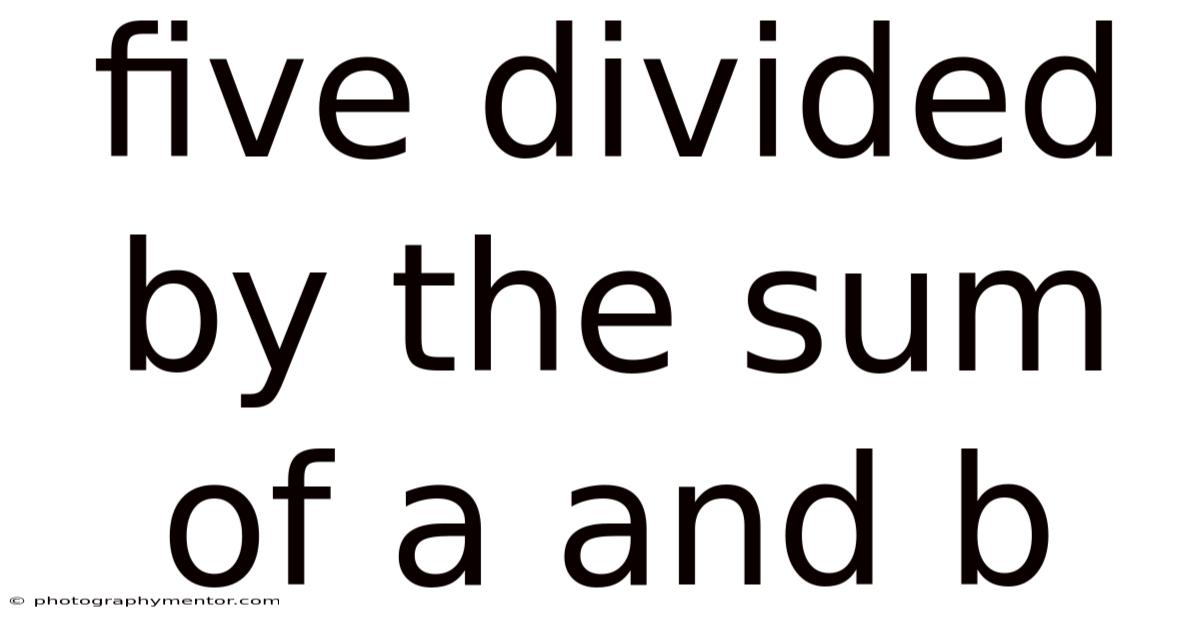
Five Divided by the Sum of a and b: A Deep Dive into Mathematical Expressions
This article explores the mathematical expression "five divided by the sum of a and b," delving into its meaning, applications, potential complexities, and practical examples. Understanding this seemingly simple expression forms a foundation for more complex algebraic manipulations and problem-solving. We'll examine its construction, explore different ways to represent it, and address potential issues that may arise when working with variables. This full breakdown is designed for students and anyone seeking a clearer understanding of fundamental mathematical concepts.
Understanding the Expression
At its core, the phrase "five divided by the sum of a and b" translates directly into a mathematical expression: 5 / (a + b). This expression indicates that the number 5 is being divided by the result of adding two variables, 'a' and 'b'. The parentheses are crucial; they dictate the order of operations, ensuring that 'a' and 'b' are added before the division takes place. Without parentheses, the expression would be interpreted differently, leading to an incorrect result.
The expression's simplicity belies its importance. Which means it showcases fundamental arithmetic operations (addition and division) combined with the use of variables, a cornerstone of algebra. Variables, represented by letters like 'a' and 'b', let us express mathematical relationships in a general form, applicable to a wide range of numerical values.
Representing the Expression in Different Ways
While 5 / (a + b) is the most straightforward representation, there are alternative ways to express the same mathematical concept:
-
Fraction Form: This is arguably the clearest way to represent the division: ⁵⁄₍ₐ₊♭₎. This format emphasizes the division as a ratio The details matter here..
-
Using the Division Symbol (÷): 5 ÷ (a + b). While functional, this notation is less commonly used in higher-level mathematics due to the potential for ambiguity.
-
Using a Function Notation: We could define a function, f(a,b) = 5/(a+b). This is particularly useful when dealing with more complex scenarios or when the expression forms part of a larger function.
Regardless of the representation used, the underlying mathematical operation remains the same: division of 5 by the sum of a and b. Choosing the most appropriate representation often depends on the context and the level of mathematical sophistication required.
Evaluating the Expression: Examples and Applications
To fully grasp the concept, let's work through some examples:
Example 1: Let's assume a = 2 and b = 3. Substituting these values into the expression, we get:
5 / (2 + 3) = 5 / 5 = 1
Example 2: Now, let's use a = -1 and b = 6:
5 / (-1 + 6) = 5 / 5 = 1
Example 3: Let's explore the case where a = 4 and b = -4:
5 / (4 + (-4)) = 5 / 0
This example highlights a critical point: division by zero is undefined. Also, this means the expression 5 / (a + b) is only defined when (a + b) ≠ 0. This constraint is essential to remember when working with this type of expression. If you encounter a situation where (a + b) = 0, the expression is invalid, and the calculation cannot be performed.
Practical Applications
The simple expression "five divided by the sum of a and b" might seem trivial, but it finds application in various areas:
-
Averaging: While not directly an average, the expression can be adapted to calculate an average if the '5' represents a total and (a+b) represents the number of items. To give you an idea, if 5 represents a total of 5 kg of rice distributed amongst 'a' and 'b' families, the expression gives the average amount of rice each family receives.
-
Rate Calculations: Consider a scenario involving speed or unit rates. If 5 units of work are to be divided among a and b workers, the expression provides the work assigned per worker Took long enough..
-
Proportions: The expression could represent a proportion in which 5 is the total, and (a+b) is a part of the whole Simple, but easy to overlook. Worth knowing..
-
Algebraic Equations: The expression could form part of a larger algebraic equation, requiring solving for 'a' or 'b' given a specific value for the entire expression. Take this: you might have an equation like: 5/(a+b) = 2, where you would solve for the values of a and b It's one of those things that adds up. Surprisingly effective..
Handling Complexities and Potential Issues
While the basic application is straightforward, some complexities can arise:
-
Negative Numbers: The expression works perfectly with negative numbers, as long as the sum (a + b) doesn't equal zero. Remember to follow the rules of arithmetic concerning the signs.
-
Fractional Values: 'a' and 'b' can be fractions or decimals. The same rules of arithmetic apply; you'll need to perform the addition and division accordingly.
-
Variables with Unknown Values: Solving for 'a' or 'b' requires algebraic manipulation. You might need to rearrange the expression to isolate the variable you are seeking.
-
The Undefined Case (Division by Zero): This is the most critical issue. Always check the value of (a + b) to ensure it is not zero before performing the division. Ignoring this precaution will result in an invalid calculation.
Expanding the Concept: Beyond 5
The principle illustrated here can be easily extended. Instead of 5, we could have any other number: x / (a + b), where x represents any number. The same rules regarding division by zero and order of operations apply. This generalization highlights the broader significance of the concept.
Frequently Asked Questions (FAQ)
Q1: What if a or b are zero?
A1: If either 'a' or 'b' is zero, the expression simplifies, but the principle remains the same. On top of that, you perform the addition first and then the division, always ensuring you don't divide by zero. To give you an idea, if a = 0 and b = 5, the expression becomes 5 / (0 + 5) = 1.
Q2: How do I solve for a if I know the value of the expression and b?
A2: This requires algebraic manipulation. So let's say the expression equals 'c'. That's why then we have: c = 5 / (a + b). To solve for 'a', multiply both sides by (a + b): c(a + b) = 5. Then, expand: ca + cb = 5. Isolate 'a': ca = 5 - cb. So finally, solve for 'a': a = (5 - cb) / c. Remember that c cannot be zero.
Q3: Can I use this expression with complex numbers?
A3: Yes, the expression can be used with complex numbers. The addition and division operations for complex numbers follow specific rules, but the fundamental concept of the expression remains the same Still holds up..
Conclusion
The expression "five divided by the sum of a and b," while seemingly simple, provides a valuable foundation for understanding fundamental algebraic concepts. Day to day, by mastering this seemingly elementary concept, we lay a strong groundwork for tackling more complex mathematical problems and expanding our understanding of mathematical relationships. The flexibility of this expression, its adaptability to various applications, and the potential for algebraic manipulation all highlight its importance in mathematical education and beyond. It illustrates the importance of order of operations, the use of variables, and the critical consideration of division by zero. The key takeaway is that a thorough understanding of this simple concept enhances problem-solving abilities in more advanced mathematical contexts.
