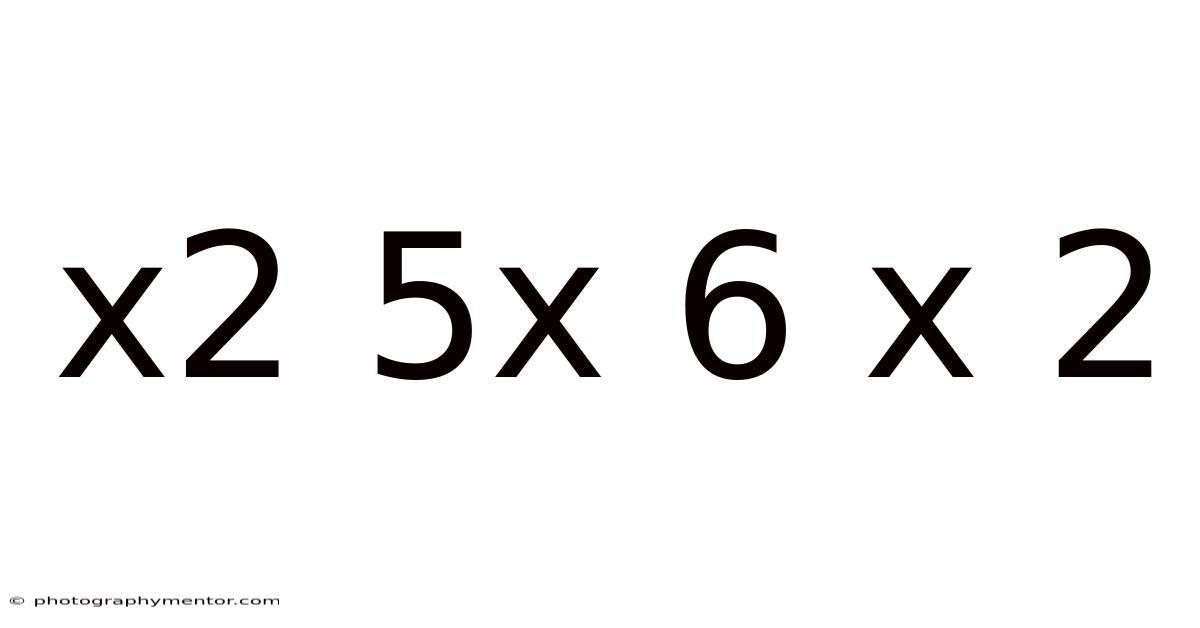
Decoding the Mathematical Expression: x² + 5x + 6 = 0
This article breaks down the seemingly simple yet profoundly important mathematical expression: x² + 5x + 6 = 0. We'll explore its solution through various methods, uncovering the underlying principles of quadratic equations and their applications in numerous fields. Understanding this equation is a cornerstone for more advanced mathematical concepts No workaround needed..
Introduction: Understanding Quadratic Equations
The expression x² + 5x + 6 = 0 is a quadratic equation. The general form of a quadratic equation is ax² + bx + c = 0, where 'a', 'b', and 'c' are constants, and 'a' is not equal to zero. A quadratic equation is a polynomial equation of the second degree, meaning the highest power of the variable (in this case, 'x') is 2. In our specific equation, a = 1, b = 5, and c = 6.
Quadratic equations are fundamental in mathematics and have wide-ranging applications in physics, engineering, computer science, economics, and many other disciplines. They model various phenomena, from the trajectory of a projectile to the growth of populations. Solving these equations is therefore a crucial skill.
It sounds simple, but the gap is usually here.
Method 1: Factoring the Quadratic Equation
This is often the quickest and most intuitive method for solving simple quadratic equations like ours. Factoring involves expressing the quadratic as a product of two linear expressions. We are looking for two numbers that add up to 'b' (5) and multiply to 'c' (6). These numbers are 2 and 3.
You'll probably want to bookmark this section.
That's why, we can rewrite the equation as:
(x + 2)(x + 3) = 0
This equation is true if either (x + 2) = 0 or (x + 3) = 0. Solving for x in each case gives us:
x + 2 = 0 => x = -2 x + 3 = 0 => x = -3
Thus, the solutions to the quadratic equation x² + 5x + 6 = 0 are x = -2 and x = -3. These are also known as the roots or zeros of the equation.
Method 2: Using the Quadratic Formula
The quadratic formula is a powerful tool that provides the solutions for any quadratic equation, regardless of whether it can be easily factored. The formula is derived from completing the square method and is given by:
x = [-b ± √(b² - 4ac)] / 2a
Substituting the values from our equation (a = 1, b = 5, c = 6) into the formula, we get:
x = [-5 ± √(5² - 4 * 1 * 6)] / (2 * 1) x = [-5 ± √(25 - 24)] / 2 x = [-5 ± √1] / 2 x = (-5 ± 1) / 2
This gives us two solutions:
x = (-5 + 1) / 2 = -4 / 2 = -2 x = (-5 - 1) / 2 = -6 / 2 = -3
As expected, we obtain the same solutions as with the factoring method: x = -2 and x = -3 Worth knowing..
Method 3: Completing the Square
Completing the square is a technique used to manipulate the quadratic equation into a perfect square trinomial, making it easier to solve. The steps are as follows:
-
Move the constant term to the right side: x² + 5x = -6
-
Take half of the coefficient of x (5/2), square it ((5/2)² = 25/4), and add it to both sides:
x² + 5x + 25/4 = -6 + 25/4
- Rewrite the left side as a perfect square:
(x + 5/2)² = -24/4 + 25/4 = 1/4
- Take the square root of both sides:
x + 5/2 = ±√(1/4) = ±1/2
- Solve for x:
x = -5/2 ± 1/2
This yields the two solutions:
x = -5/2 + 1/2 = -4/2 = -2 x = -5/2 - 1/2 = -6/2 = -3
Again, we arrive at the same solutions: x = -2 and x = -3.
Graphical Representation and the Discriminant
The solutions of a quadratic equation can also be visualized graphically. Think about it: the graph of a quadratic equation is a parabola. Practically speaking, the x-intercepts of the parabola represent the roots of the equation. In our case, the parabola intersects the x-axis at x = -2 and x = -3.
The discriminant, represented by Δ (delta) and calculated as b² - 4ac, provides information about the nature of the roots:
- Δ > 0: Two distinct real roots (as in our example).
- Δ = 0: One real root (a repeated root).
- Δ < 0: Two complex roots (roots involving imaginary numbers).
In our equation, Δ = 5² - 4 * 1 * 6 = 1, which is greater than 0, confirming the existence of two distinct real roots It's one of those things that adds up..
Applications of Quadratic Equations
The applications of quadratic equations are vast and diverse. Here are a few examples:
-
Physics: Calculating the trajectory of a projectile, determining the time it takes for an object to fall a certain distance, analyzing the motion of simple harmonic oscillators.
-
Engineering: Designing bridges, calculating stresses and strains in structures, optimizing the shape of antennas Easy to understand, harder to ignore..
-
Economics: Modeling supply and demand curves, analyzing profit maximization, forecasting economic growth.
-
Computer Science: Developing algorithms for optimization problems, creating computer graphics, designing video games Not complicated — just consistent..
-
Finance: Calculating compound interest, determining the present value of future investments, analyzing the growth of investments.
These are only a few examples; quadratic equations underpin countless models and calculations in various fields.
Further Exploration: Higher-Degree Polynomial Equations
While this article focused on quadratic equations, the principles discussed extend to higher-degree polynomial equations. Solving cubic equations (degree 3), quartic equations (degree 4), and beyond, requires more advanced techniques, often involving numerical methods for complex equations that lack straightforward analytical solutions Practical, not theoretical..
Frequently Asked Questions (FAQ)
-
Q: What if the coefficient 'a' is zero? A: If 'a' is zero, the equation is no longer quadratic; it becomes a linear equation, which is much simpler to solve.
-
Q: Can a quadratic equation have only one solution? A: Yes, if the discriminant (b² - 4ac) is equal to zero, the quadratic equation has exactly one real root (a repeated root) The details matter here..
-
Q: What are complex roots? A: Complex roots are solutions that involve the imaginary unit 'i', where i² = -1. They occur when the discriminant is negative.
-
Q: Are there other methods to solve quadratic equations? A: Yes, numerical methods like the Newton-Raphson method can be used to approximate the roots of quadratic (and other) equations, particularly for equations that are difficult to solve analytically.
Conclusion: Mastery of Quadratic Equations
The seemingly simple equation x² + 5x + 6 = 0 serves as a gateway to understanding the broader world of quadratic equations. Worth adding: mastering the techniques of factoring, using the quadratic formula, and completing the square not only equips you with the ability to solve these equations but also provides a solid foundation for more advanced mathematical concepts and their applications in diverse fields. The understanding of this fundamental equation opens doors to a deeper appreciation of mathematics and its power to model and solve real-world problems. Remember, the journey of learning is continuous; this is just the beginning of your exploration into the fascinating world of mathematics!
